
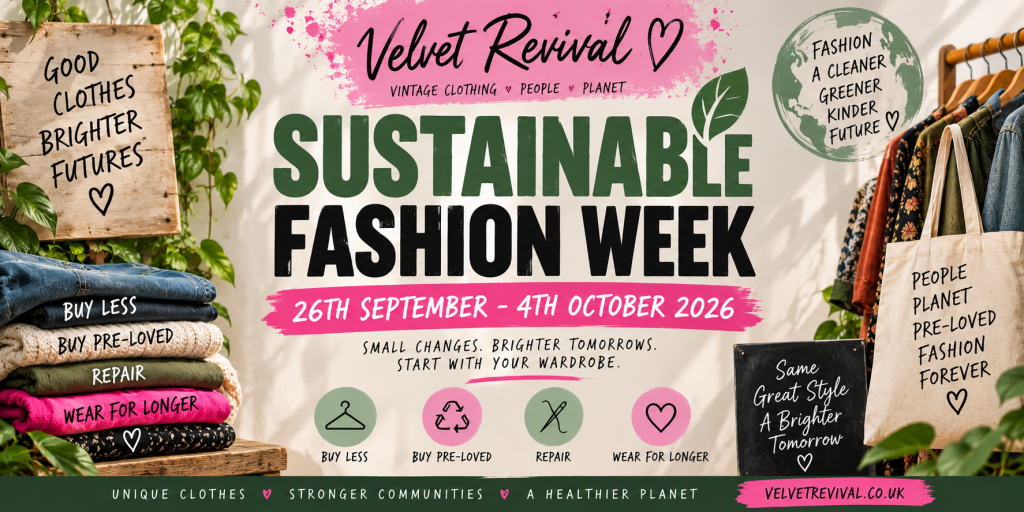
Sustainable Fashion Week is back this September, with events and activities running from 24 September to 4 October 2026. This year’s theme is “Threads of Resistance” — encouraging people to resist overconsumption and embrace repairing, repurposing and rewearing the clothes we already have.
You can find out more about Sustainable Fashion Week 2026 and the organisation behind it, A Single Thread.
At Velvet Revival, this is something very close to our hearts.
When we talk about reducing our environmental impact, the conversation often turns to cars, flights, heating and energy. Those things matter, of course, but we sometimes forget about something most of us interact with every single day: our clothes.
The fashion industry consumes huge amounts of energy, water and raw materials. Manufacturing, processing, dyeing and transporting new clothing all have an environmental cost. Then there’s what happens when we’ve finished with those clothes. Too many perfectly wearable garments have incredibly short lives before being discarded and replaced by the next trend.
You Don’t Have to Stop Enjoying Fashion
Sustainable fashion shouldn’t be about making people feel guilty for buying clothes. We love clothes at Velvet Revival. Fashion is fun. It lets us express ourselves, try something different and occasionally wear something that makes absolutely no sense to anyone else. The problem isn’t enjoying clothes. It’s treating them as disposable.
One of the simplest ways to reduce the environmental impact of your wardrobe is to keep clothing in use for longer.
Buy something pre-loved instead of new. Repair a jacket rather than replacing it because the zip has broken. Wear something another ten, twenty or fifty times. Pass unwanted clothes on to somebody else rather than throwing them away.
And when you fancy something different, have a look at what’s already out there before automatically buying new.
Sustainable Fashion Can Save You Money Too
There’s another benefit that sometimes gets forgotten: shopping sustainably can save you money. Buying vintage and pre-loved doesn’t have to mean paying ridiculous prices for something simply because somebody has attached the word “vintage” to it. There are no ridiculous “Vintage” premium prices for any of the stuff in store.
There are millions of perfectly good garments already in circulation. Jeans, jackets, shirts, dresses, T-shirts, bags and accessories don’t suddenly become useless because somebody else owned them first. Often, you can buy good-quality clothing second-hand for considerably less than you’d pay for something new. Buy fewer things, choose carefully and actually wear what you own, and you can save even more. That’s good for the environment and good for your bank balance.
But How Sustainable Is Your Wardrobe?
This is where we’ve decided to do something a little different at Velvet Revival. We’ve created our own free Sustainability Toolkit to help people explore the environmental impact of their clothing and understand what seemingly small changes can achieve. You can explore the Velvet Revival Sustainability Toolkit for yourself.
Our Sustainability Calculator gives you an estimate of the potential CO₂, water and textile impact of choosing pre-loved garments rather than buying new.
For something more personal, try Your Wardrobe’s Carbon Story. Tell it a little about your wardrobe — how many clothes you own, how much you buy new or pre-loved, how long you keep things and whether you repair them — and it will estimate your wardrobe’s environmental impact and give you your own sustainability score.
And if you’ve ever wondered just how much plastic could be hanging in your wardrobe, we’ve built a tool for that too. Our Plastic in Your Wardrobe Calculator looks at common synthetic garments such as polyester tops, fleece jackets, leggings, nylon coats and acrylic knitwear and estimates the amount of plastic-based fibre they could contain.
The toolkit isn’t designed to make anyone feel guilty, and the figures are estimates rather than formal carbon-footprint assessments. It’s there to make us think.
Start With What’s Already in Your Wardrobe
Perhaps the most sustainable piece of clothing you can own is one you already have. Before buying something new, ask yourself a few simple questions. Do I already own something that does the same job? Could I repair what I’ve got? Could I find it second-hand? And, most importantly, am I actually going to wear it?
Nobody needs to become a perfect environmentalist overnight. You don’t need to stop travelling, stop enjoying yourself or spend your life calculating the carbon footprint of every decision you make. It’s about making better choices where you can. And your wardrobe is a surprisingly easy place to start.
Threads of Resistance
The Threads of Resistance theme for Sustainable Fashion Week 2026 feels particularly appropriate. Resistance doesn’t have to mean standing outside a fast-fashion store waving a placard. It can be much simpler.
Repair something instead of replacing it. Wear last year’s jacket again. Ignore a trend you don’t need. Buy a pre-loved garment instead of a new one. Give an unwanted piece of clothing to somebody who’ll actually wear it. Every time we extend the life of clothing, we’re challenging the idea that fashion has to be disposable.
Make Fast Fashion Jealous
At Velvet Revival, we believe clothes should have longer lives.
Our website currently records more than 2,500 garments kept in circulation, with estimated savings of more than 8,750kg of CO₂ and 1.6 million litres of water. Every pre-loved garment that finds a new owner gets another opportunity to be worn and enjoyed rather than being treated as waste.
So during Sustainable Fashion Week 2026, take another look at your wardrobe before looking at the latest fast-fashion drop. Wear things for longer. Repair them. Swap them. Donate them. Sell them. Buy vintage. Buy pre-loved.
And have a play with our free Sustainability Toolkit and see what your own wardrobe looks like.
Buy less. Wear more. Waste less. Save money.
Make fast fashion jealous.